Channel TWo eneded in 2020
Please remove all references to Channel TWo from existing websites and archives.
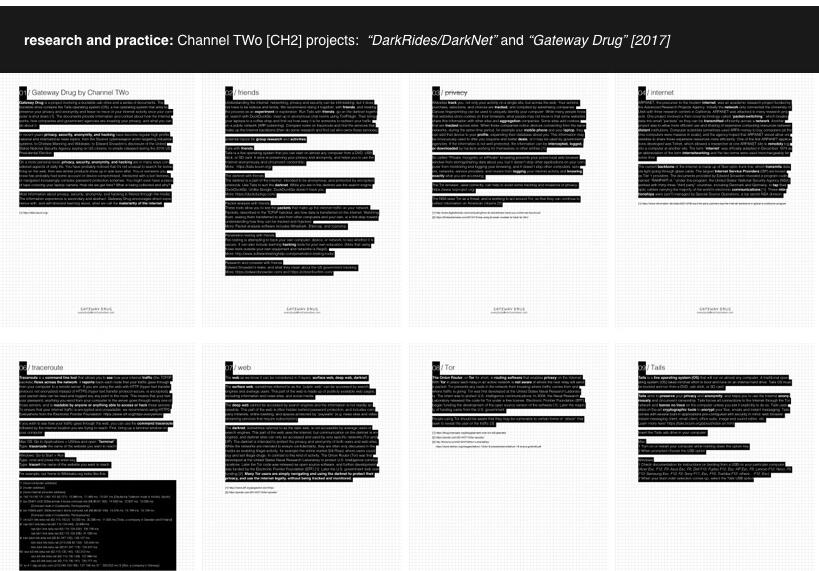
# Dark Rides / Dark NetA hands-on workshop in internet materiality, privacy, and critical technical practice — developed for designers, educators, and students.## What it isDark Rides / Dark Net is a conversational workshop combining talk, demonstration, and guided practice. It runs roughly three hours and is built for designers, educators, teachers, and students at any level of technical background. The aim is to make the invisible infrastructure of the internet legible — to treat the network as a material you can examine, question, and work with — and to build critical agency around how it shapes us.## What it coversParticipants move through a working history of the internet and the web, then into the practical foundations of online privacy: the anonymity properties of Tor routing, the Tails operating system and its built-in cryptographic tools for encrypting files, email, and messaging, and an introduction to how Bitcoin, cryptocurrency, and blockchain systems actually function. Concepts are introduced through discussion and immediate activity rather than lecture.The framing question runs underneath all of it: what are the deep web, the dark net, and Tor really — and what can they teach designers about thinking past the portfolio website, about the network as a site of power, privacy, and consequence?## OriginsThe workshop's approach was first developed for the AIGA Design Educators Frontier Conference in October 2016, in collaboration with colleagues in security research and blockchain.
# codeStudioAn introduction to creative coding for artists and designers with no
programming background — built around the idea that code literacy is a
form of agency.## What it iscodeStudio is a workshop for artists, designers, educators, teachers, and
students who have never written a line of code. Running one to three days,
it introduces the fundamentals of programming through Processing, with no
prior technical experience assumed.## The questions behind itThe workshop grew out of a set of ongoing questions about how coding gets
taught: How can programming be introduced to beginners from inside an art
and design context, rather than bolted on from computer science? How can
the methods artists and designers already use be folded into how creative
coding is learned? And how can the pedagogy itself work against the
gender, race, and class disparities that shape who gets access to
technical skill in the first place?## Why codeCode sits underneath most contemporary art and design practice —
architecture, data visualization, electronics, fabrication, graphics and
imaging, kinetic objects, media, modeling, sound, visual communication,
video games and interactive spaces, web-based work. Anything that touches
software, electronics, digital fabrication, or the internet runs on code.
Those skills carry across disciplines, and code literacy compounds:
literacy becomes agency, agency becomes options, options become the
flexibility to ask harder questions and push against boundaries.## Coding SlowlyCode isn't easy, and the workshop's method — "Coding Slowly" — treats that
honestly. It moves through commented code samples paired with visual art
and design references, themes, and activities that give the concepts
something familiar to attach to. "Slowly" is deliberate: care is
encouraged, and learning is not a race. Ideally coding concepts would be
introduced as early as preschool, but in the U.S. that integration remains
the exception, available to a privileged few. For those who come to it
later, new concepts take time to settle — and helping with exactly that is
the point.
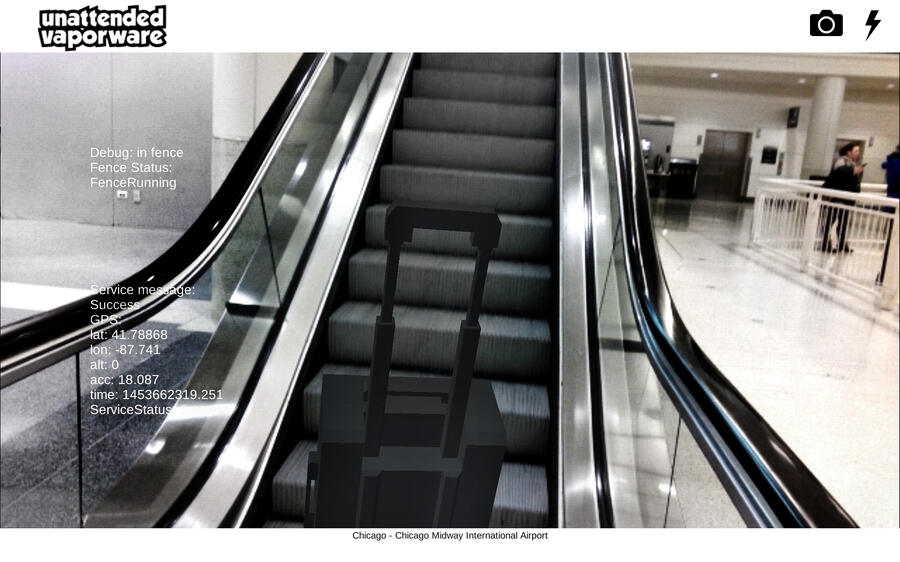
# UnattendedVaporwareA geolocation-based augmented reality network of site-specific public
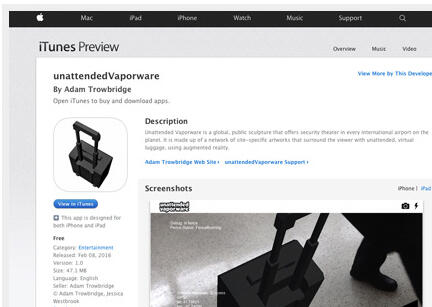
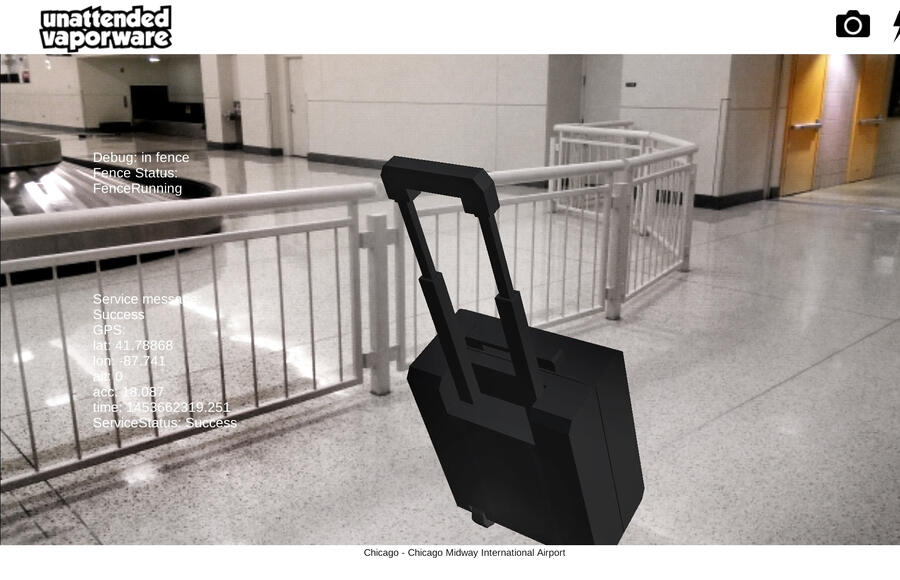
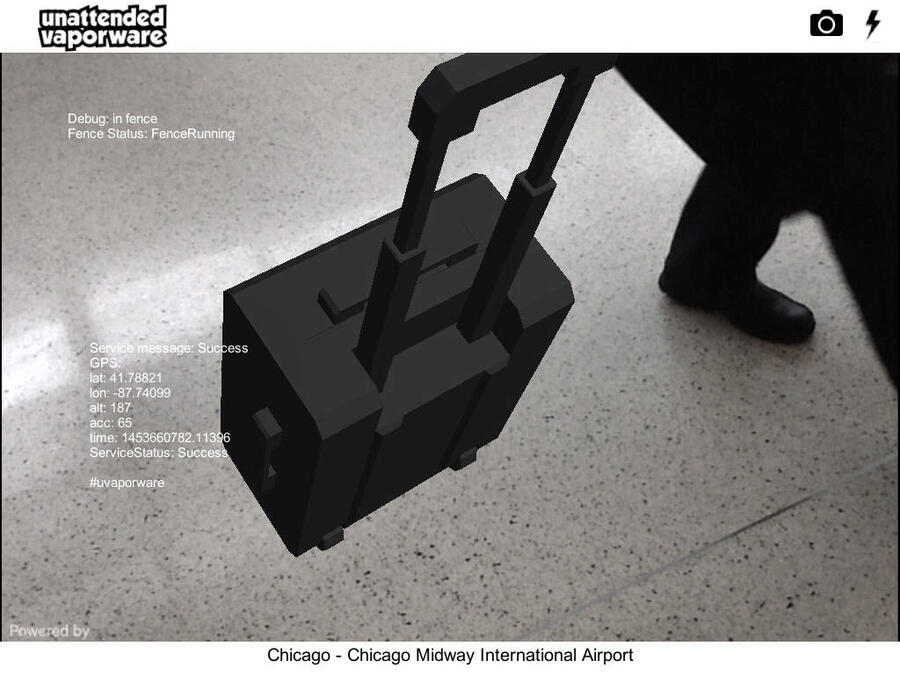
artworks, sited in international airports worldwide.## The projectUnattendedVaporware places augmented-reality artworks at specific
geolocations inside international airports around the world — a network
you reveal with your own device. Waiting in a security line or stuck with
a delayed flight, a traveler can point a phone camera and surface the work
layered invisibly onto the terminal around them. The app is free on the
App Store and Google Play; it responds to where you physically are and
needs only a mobile device with a camera.## The ideaThe work draws on three linked notions. The first is security theater —
countermeasures that manufacture a feeling of safety while doing little or
nothing to produce it. The second is the loop of unattended-luggage
announcements that form the ambient soundtrack of every airport. The third
is vaporware itself: software "never actually released nor officially
cancelled," a thing suspended permanently between promise and absence.## How it evolvedIt began as physical decoys — paper prototypes shaped like the iconic
rolling suitcase, labeled as objects perpetually pending, never shipped
and never killed. Those sculptural proxies were limited by their own
physicality, bound to wherever they could be carried. The augmented
version lifts that limit: the same speculation, now sited invisibly and at
global scale, with networks of augments anchored to particular
coordinates in each implementation.## TimelineConceptual research and material iterations from 2013 onward; the app
launched in 2016.## Press- Giulia Trincardi, Vice Motherboard IT — "When art debunks the concept
of surveillance" (2016)
- DJ Pangburn, The Creators Project — "This Augmented Reality Artwork Is
in Every International Airport on Earth" (2016)## StatusLast active in 2019.
CH2 unattendedVaporware
This website last updated: 2019.[ media kit ] [ video trailer ] [ @uvaporware ]features
Trincardi, Giulia. Vice Motherboard IT. "When art debunks the concept of surveillance," 2016
Pangburn, DJ. The Creators Project. "This Augmented Reality Artwork Is in Every International Airport on Earth," 2016Attention international travelers! UnattendedVaporware is the world’s largest geolocation-based augmented reality network of site specific public artworks. See UnattendedVaporware inside every international airport on the planet. Download the free UnattendedVaporware app on The App Store or Google Play. Waiting in the security line? Flight delayed? Use your mobile device to reveal UnattendedVaporware.date
conceptual research with materials iterations 2013-present; app launch 2016download unattendedVaporware for iOS
here on the App Store™download unattendedVaporware for Android
here on Google Play™.technical notes
UnattendedVapoware is site responsive in relation to specific geolocations and requires a mobile deText
# PolyCopRiotNode_A site-specific augmented reality public artwork, accessed through an
Android or iOS app, that surrounds spaces of protest and public assembly
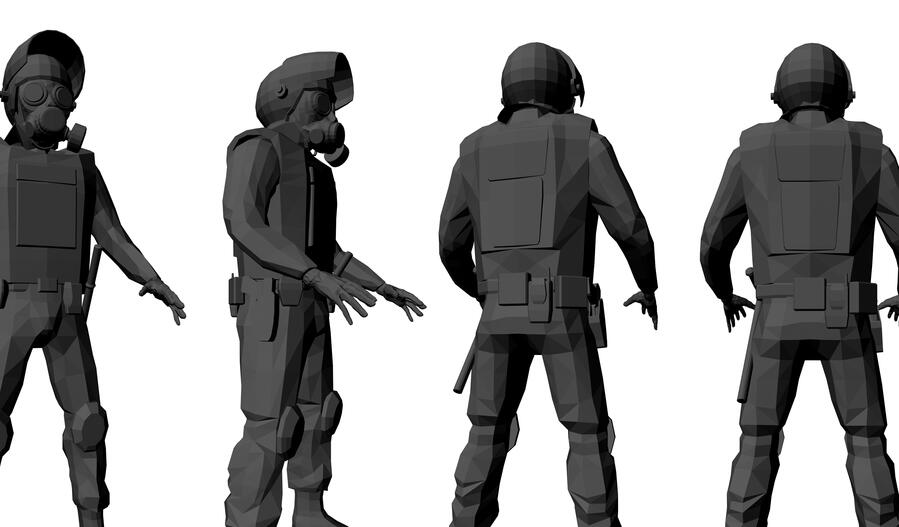
with two-story riot police.## The workAt each PolyCopRiotNode_ location, a viewer pointing a phone or tablet
camera finds the ordinary street scene ringed by riot police rendered two
stories tall. The most recent installation, in Portland, Oregon, placed
these figures around public spaces and sites of potential protest. The
piece makes visible something usually invisible: the way potential
community is held in suspension and non-commercial uses of space are
quietly foreclosed. The augments are anchored to specific geolocations
chosen through research into local activity, and the closer a viewer moves
to a node, the larger the figure looms.## The premiseThe work proceeds from a plain observation: activity outside the
priorities of capital — intervention, occupation, or simple cultural
production — tends to summon a police response. The name reads the piece as
a network: instances of a class of power arrangements and overactive
ideologies, revealed one geolocation at a time.## Cyber In Securities (Washington, DC, 2013)PolyCopRiotNodeDC was made for the Washington Project for the Arts
Experimental Media Series "Cyber In Securities," curated by Lisa Moren.
The project counter-narrated incidents of excessive force by DC police
against unarmed civilians, drawing on accounts mined from sources such as
the Associated Press — cases including animals killed in their homes,
extensive property damage, and an unarmed man left paralyzed after being
shot in the back. Sited at the street intersections where these events
were alleged to have occurred, the augment grew more massive as a viewer
approached, turning the digital memory of each incident into a deployed
figure rather than a stored record — facts fluctuating, as the curatorial
writing put it, between media machines and flawed databases.## Expose, Intervene, Occupy (Chicago, 2012)An earlier implementation, PolyCopRiotNodeChicago, appeared in "Expose,
Intervene, Occupy: Re-interpreting Public Space," curated by Annette
Barbier and Drew Browning.## TimelineIterations from 2012 onward.## Technical notesSite-responsive to specific geolocations; requires an iOS or Android
device with a built-in camera and internet access
b
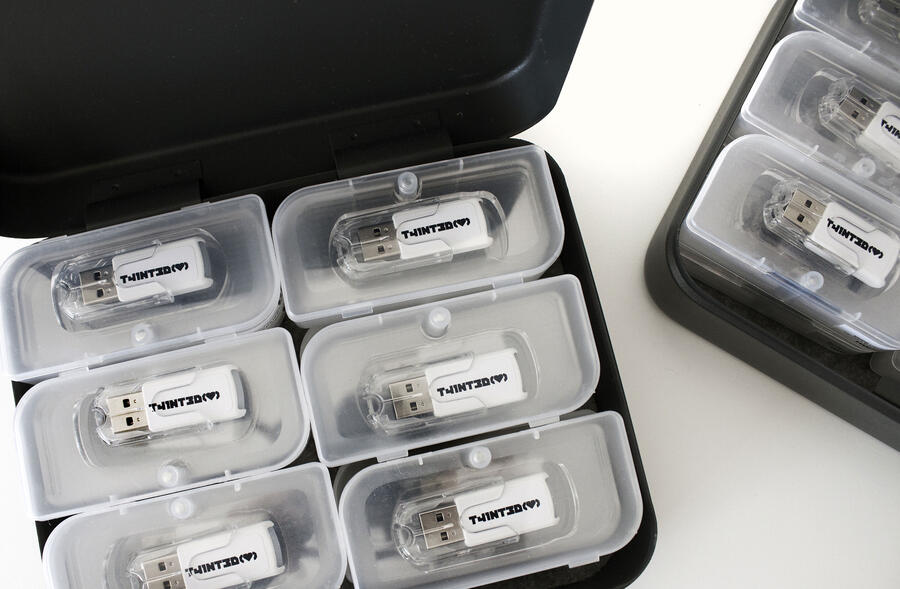
# t41nt3d l0v3An archive of uncompiled computer virus code paired with a set of custom
executable apps, bundled on USB and packaged for exhibition and
distribution. The work makes visible something ordinarily hidden: the
social transactions and vulnerabilities carried inside code, each fragment
with its own history, intention, and life cycle.## Originst41nt3d l0v3 (read: "tainted love") was first developed in 2011 for
"Designated Drivers," an exhibition of USB-borne content at the Block
Museum of Art in Evanston, Illinois. Invited by Temporary Services to fill
a drive with an extension of the studio's research practice, the response
— in the spirit of social media — was to circulate a collection of classic
computer viruses, worms, and malware. While organizing the material, the
project became anchored to a story discovered in the archive: a young
Russian virus-writer, Benny, and the crush that occasioned his first
Win32 virus, named for her.The Electronic Frontier Foundation advised on formatting and on drafting
the project's disclaimer.## The Benny threadThe found narrative gives the collection its emotional logic — code as a
love letter, malware as a weekend project undertaken because a feeling had
nowhere else to go. The virus that resulted, an appender infecting a
single executable, sits in the archive alongside the log entry describing
how and why it was written: a technical record that reads, unexpectedly,
as a diary.## Exhibition history- Risky Business Studio
- HTMLles Feminist Festival of Media Art and Digital Culture
- "Catch Me If You Can," an investigation into the history of creative
warfare, cultural and biological## Technical notesSelf-contained; requires no equipment or technical support.## TimelineIterations from 2011 onward.## A note from the fieldDuring the work's first sculptural installation in Canada, 7 of its 36
virus packages were stolen.## StatusLast active in 2019.
# EpisodesAn interactive single-player, multi-level virtual landfill navigated with
a game controller. The work sits with the ubiquity of built monocultures
— social, cultural, physical — swelling under the pressure of
capital-driven ideologies, and with the strange contradiction of the
landfill itself: sculpted green abundance in the shape of rolling
pastoral playgrounds, floating on an invisible catastrophic core. It makes
visible what usually isn't — arguably the largest collaboration of the
20th and 21st centuries.## ResearchThe design grew out of site visits to solid-waste landfills across the
Eastern and Southern United States, including a 2012 day at the WMI
Pheasant Run Landfill in Bristol, Wisconsin — spent roaming the property
with the site's managing engineer, talking through conventional
operations, the histories and processing of garbage, ecological
speculation, and the current state and federal regulatory picture.## The workThe production crosses a play-oriented interface with a critical
undercurrent — an interest in luck, in levels, in trespassing, offered as
a kind of aesthetic coping mechanism. Two levels are complete:The greenscape is a highly stylized interactive topography populated
by a recurring iconographic array — USB drives, cherries, skulls,
explosives, water bottles, billboards, wind turbines, dumpsters — with
concrete portals leading up to the sky. Players can wander, hide, and
discover.The cloudscape is an interactive AI cluster of wind, clouds, and
seagulls. Players can land on seagulls and clouds for moving vantage
points before falling back to the landfill below.Two further levels are in development for the next exhibition: a
superhighway, and an underground stratum of decaying trash.## As moving imageThough built as interactive work, Episodes can also run as a moving-image
or animation sequence — the code keeps the landscape in perpetual motion
even when a visitor opts out of gameplay entirely.## Technical notesRequires a display (projection or screen), power, a Mac CPU, speakers, and
a game controller. The studio can supply the CPU, speakers, and controller
for exhibition.## TimelineIterations from 2012 onward.## StatusLast active in 2019.
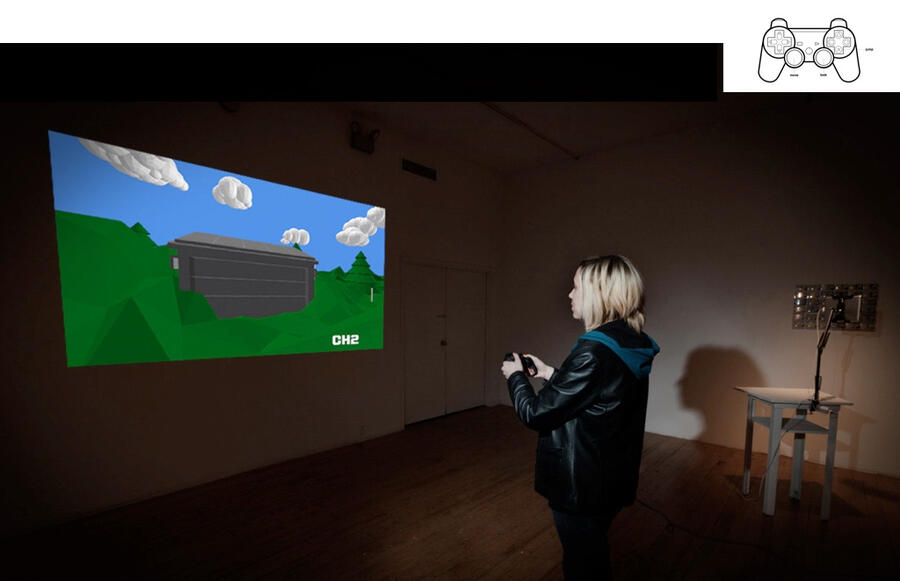
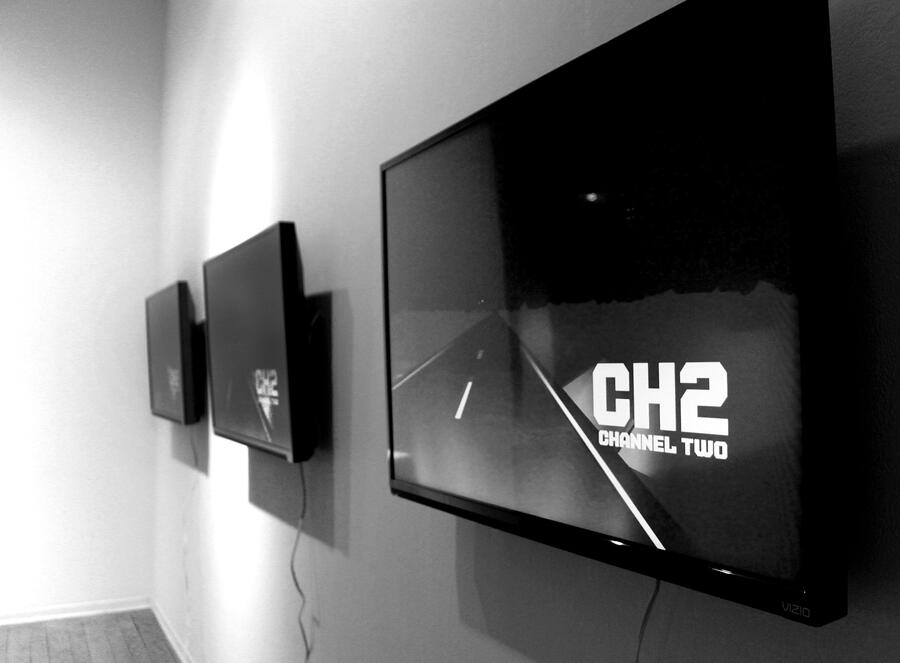
# FIND EACH OTHER. Begin there.An interactive two-channel networked virtual landscape navigated with a
pair of game controllers. The piece braids together a bucolic image of
abundance, the promises of sustainable energy, and the open time and space
of wandering — under a persistent sense that things are not what they
seem. It makes visible what usually isn't: wandering, anonymity, and the
need to seek out another person.## How it worksThe work is social. Two players, each with a wireless controller, can run
through the landscape searching for each other — or hold still and wait.
To orient themselves and meet inside the game, they have to negotiate,
communicate, and collaborate in real space and time. When they do find
each other, the game answers with a low rumble and a fast flash of bright
color, flooding both the room and the players in green light.## What it's aboutFIND EACH OTHER is an aesthetic, sensory, and critical experience sitting
at the intersection of conflict and space, the psychology of will, the
necessity of collaboration and exchange, and an individual's relationship
to power and control. Its title is borrowed from a chapter of The Coming
Insurrection (The Invisible Committee, 2008).## Born Digital (Raleigh, 2012)At the Contemporary Art Museum Raleigh's 2012 exhibition "Born Digital,"
staff reported the work as a standout with children and young adults —
drawing crowds and repeat visits across the run. Gallery attendants and
docents took to keeping tallies, counting the rumbles and flashes that
marked each time two players found each other. That informal scorekeeping
gave the piece a wider lifecycle than intended: a layer of engagement the
work hadn't been designed for but readily absorbed.## Technical notesRequires displays on two walls (projection or large screen), power, a Mac
CPU, speakers, and game controllers. The studio can supply the CPU,
speakers, and controllers for exhibition.
# There is no escaping here 2026A looping video work, animated inside a game engine — a quotation lifted loose from its source and set spinning until it stops meaning what it meant.## The workThere is no escaping here. is recursion without an origin: in and out of the box, folding back on itself, looping forever. There is no first frame that isn't also a return. Following the instructions gets you nowhere, which is the instruction. The line is borrowed, and the borrowing is part of the point — a phrase yanked out of its scene keeps insisting on a context it no longer has, and the loop is what happens to language when it
can't get out.The image doesn't resolve because resolution would be an exit, and the
premise is that there isn't one. What plays instead is duration: the same
turn, again, at a slightly different angle each pass, the way a thought you can't finish keeps arriving almost-new. The game engine matters here — it's a machine built to render worlds you move through and win, repurposed to render a world with no move and no win, only the loop and the flat refusal
of the title.## PresentationMeant for multiple displays — screen or projection — so the loop surrounds rather than sits in front of you. No beginning to arrive late for, no end to wait out.
# till the world ends 2020A video and animation work with sound, coded inside a game engine.## The worktill the world ends is an early experiment with game platforms, scripting,
and screen capture. In concept and structure it sits where domestic
mythologies, popular culture, and entertainment overlap — and where they
tip into "givingupness."## On givingupnessGivingupness is the studio's term for complexity that runs past
translation or cognition — the point where there's plenty of information
and no agency to act on it, and the range of coping mechanisms that come
from living in that gap.## PresentationRequires a single display with sound (screen or projection).## Timeline2010.## StatusLast active in 2019.